

news/articles/article
Understanding Tyre Compounds: What the Numbers Actually Mean
Every tyre manufacturer describes their products using compound designations—soft, medium, hard, or proprietary terms like "FG" or "SC1"—yet precious few riders understand what these terms actually indicate. Marketing departments have thoroughly muddied waters that were already murky, with one manufacturer's "medium" compound behaving entirely differently from another's. This guide attempts to explain the underlying principles that compound choices reflect, allowing riders to make informed decisions rather than simply trusting whatever marketing materials suggest.
Tyre rubber is not a single material but a precisely engineered composite of natural and synthetic rubbers, carbon black, silica, and various chemical additives that alter physical properties. "Compound" refers to the specific recipe of these ingredients, cooked together under controlled conditions to produce rubber with target characteristics. Softer compounds use higher proportions of natural rubber and different plasticiser ratios; harder compounds increase synthetic rubber content and alter the vulcanisation process. The resulting rubber differs in grip, wear rate, operating temperature range, and behaviour as the tyre ages.

Africa Twin vs Ténéré 700: The Middleweight Adventure Choice

Dakar 2026: Toby Price Ends KTM's Drought

Dakar 2026 Stage One: Sanders Sets Early Pace

Dakar 2026 Stage 1: Brabec Sets Early Marker
Grip and wear exist in fundamental tension. Softer rubber deforms more readily around surface irregularities, increasing the mechanical interlock between tyre and road that creates traction. But that same deformation accelerates wear—the rubber that's gripping hard is also tearing microscopically with each rotation. A racing soft tyre might deliver 20% more grip than a touring tyre while lasting one-tenth as long. For track use where lap times matter and tyres are changed frequently, this trade-off makes sense. For adventure touring where tyres must last thousands of kilometres through varied conditions, the calculation differs entirely.
Operating temperature dramatically affects how compounds perform. Soft rubber becomes optimally sticky at relatively low temperatures—perhaps 50-80°C—but degrades rapidly above its design range. Hard rubber needs more heat to reach working temperature, remaining slippery until warmed but maintaining consistent performance across a wider range. This explains why racing slicks feel greasy in the paddock but transform on hot laps, and why adventure tyres work adequately in any condition without excelling in any. The compound is engineered for the expected operating environment.

Multi-compound tyres—common in modern sport and sport-touring applications—place different compounds across the tread to optimize for different usage zones. Centre strips use harder compounds for longevity during straight-line running, while shoulder areas use softer compounds for grip during cornering. The transitions between compounds are blended to avoid abrupt handling changes as lean angle progresses. This engineering represents a genuine advance over single-compound designs, though it complicates comparisons between manufacturer specifications that may define compound zones differently.
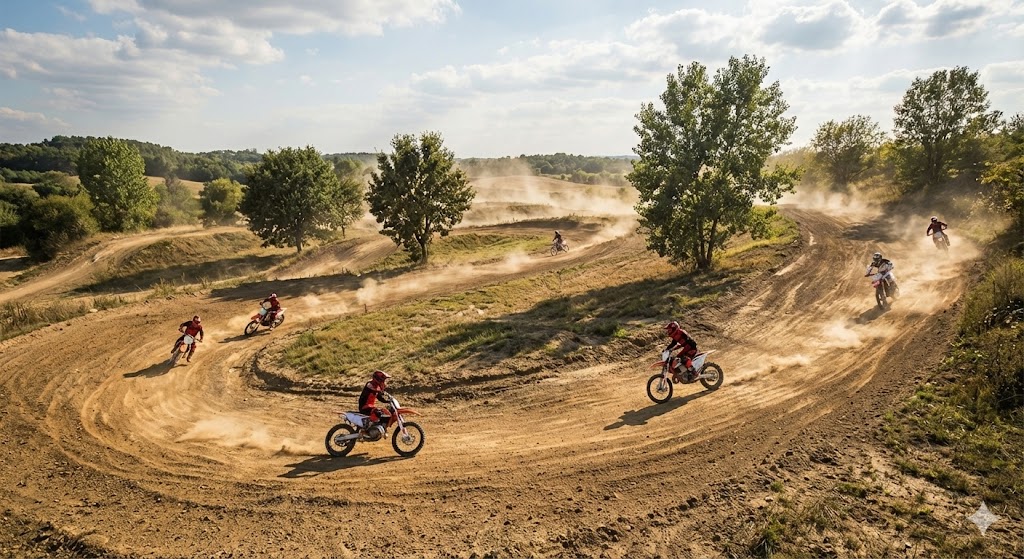
For off-road applications, compound terminology shifts toward terrain designation rather than pure hardness. "Soft terrain" tyres use rubber engineered for grip on mud and sand while maintaining knob stability—quite different priorities than road tyre soft compounds. "Hard terrain" enduro rubber optimises for rock traction and knob durability on abrasive surfaces. The words sound similar to road tyre terminology but describe different engineering priorities entirely. A soft-terrain MX tyre is not "soft" in the road tyre sense; it's designed for surfaces where road tyre concepts barely apply.